CHANGSHA, Aug. 28 (Xinhua) -- Two years after bidding farewell to poverty, residents of a village of the Miao ethnic group in central China's Hunan Province have more reasons to laugh, sing and dance.
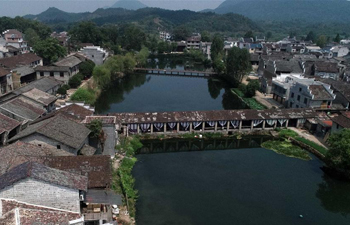
Every weekend, thousands of tourists flock to the mountainous village of Shibadong. Led by Shi Denggao, villagers cheerfully greet them with corn wine before ushering them to an array of festive activities from group dances to ancestor worship rituals.
A huge gala celebrating the Ganqiu Festival has been held here since Aug. 9. On Saturday, the village was the crowded sight of visitors watching Miao priests scaling blade ladders and riding on a wooden ferris wheel, where young maidens sang to their heartthrobs, in line with a local tradition.
In the past, the Ganqiu Festival was a one-day celebration of good harvest and a mass dating event for young men and women of the Miao ethnic group. This year, it was extended to 40 days so more tourists could join the revelry.
"Rural tourism is a promising key industry of our village," said Shi, head of the village's anti-poverty team. "In recent years, the village has seen more visitors during the Ganqiu Festival, so we decided to make the event last longer this year."
Shibadong, meaning "18 caves" in Chinese, was once so notorious for its destitution that "no outsider was willing to marry into the village." In recent years, however, it has become a paradigm of China's historic campaign to eradicate absolute poverty by 2020.
In November 2013, during an inspection tour of Hunan, President Xi Jinping visited Shibadong village, where he first put forward the concept of "targeted poverty alleviation." This concept about suiting relief policies to different causes of poverty and different local conditions has become a guiding principle in China's fight against poverty.
Since then, locals in Shibadong have shifted their focus from their scarce arable land to the local karst landscape and Miao culture. With government support, villagers have turned cottages into rustic family inns, breweries and silverware workshops opened their doors to tourists, and an art troupe has been formed to entertain tourists and preserve the original Miao-style dances.
The village dropped its "poverty-stricken" label in 2017. Its net per capita income increased to 12,128 yuan (1,712 U.S. dollars) last year, up from a paltry 1,669 yuan in 2013, which was a little more than half of the country's poverty line at 2,300 yuan.
Village tours are now the biggest contributor to Shibadong's anti-poverty campaign. Last year, the village received 300,000 visitors and reaped tourism revenue of over 3 million yuan.
Nationwide, the search for the most suitable industries has guided many areas out of poverty. In May, China's iconic revolutionary base Yan'an formally shook off poverty after local farmers planted apple trees to replace less profitable crops.
Shibadong's example demonstrates the many possibilities of developing village industries. Under Shi's leadership, the village has jumped on the tourist bandwagon to invest in "tourism-plus industries" like the production of "Shibadong mineral water" and "Shibadong chili."
"Rural tourism is seasonal, so we must also develop agricultural industries that can synergize with tourism," he said, highlighting the importance of not putting all of the eggs in one basket.
"We are at a critical transition from poverty alleviation to rural vitalization. We still have a lot of work to do," said the village poverty alleviation official.