SYDNEY, April 11 (Xinhua) -- A new species of human has been identified from remains found in a cave in the Northern Philippines, an Australian researcher said on Thursday.
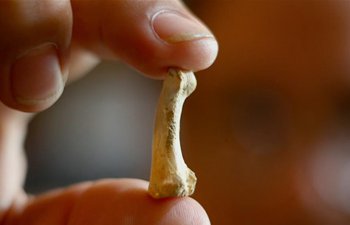
Professor Rainer Grun, Director of Griffith's Australian Research Centre for Human Evolution, used uranium series analysis to date the teeth and bones of three small hominid individuals, a child and two adults, found in Callao Cave on Luzon Island.
The 50,000-year-old remains belong to a now extinct species of human which the team have named Homo luzonensis.
Three-dimensional imaging methods and geometric morphometrics analyses show Homo luzonensis as having some attributes similar to modern humans, as well as some more suited to our distant cousins, Australopithecus.
The discovery is the oldest of human remains in the Philippines, and contributes to a changing picture of how and when Homo sapiens came to dominate the planet.
"There have been a lot of finds in this area that were not meant to be there," Grun said.
Recent discoveries of other human species like Homo floresiensis, also in the Philippines, and Homo naledi in South Africa shows these groups existed much more recently than was thought.
"The idea that at the time there were modern humans and Homo erectus in the area but no other species no longer holds up," Grun said.
"We now know that there are actually a number of different human species that were existing alongside each other," he added.
According to the team, the study underlines the major role played by Island Southeast Asia in the evolutionary history of hominins.
The project was an international effort, headed by the National Museum of Natural History in Paris and including researchers from the University of the Philippines, National Museum of the Philippines, University of Bordeaux, Paul Sabatier University, University of Poitiers and the Australian National University.