TIANJIN, Feb. 27 (Xinhua) -- Every day, a group of conservationists patrol a wetland area near a critical drinking water source for about 15 million people.
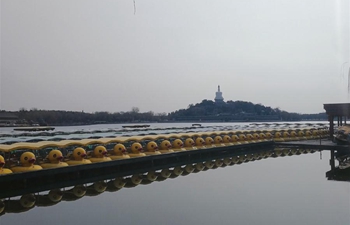
The 22-square-kilometer forebay is a maze-like wetland that acts as a buffer zone for the Yuqiao Reservoir in north China's Tianjin Municipality near Beijing. The area was established to keep water clean and control floods.
The Yuqiao Reservoir is one of over 600 national-level key drinking water sources in China. With intensive conservation efforts, what was once a crowded area of fish ponds, vegetable greenhouses and cattle sheds has been transformed into a well-protected wetland and a natural habitat for various flora and fauna.
Tianjin invested 559 million yuan (82 million U.S. dollars) for the establishment of the forebay in 2015 and started operation in August 2017, said Lian Tiehui, deputy director of Yuqiao Reservoir Management Service.
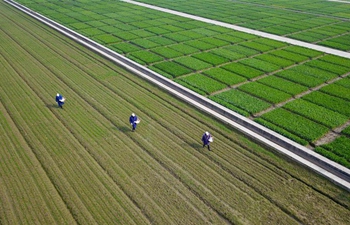
Wu Tao, 38, started to lead a team of 11 people to manage the forebay station last year. The forebay is divided into 43 lots, where different types of plants are grown.
"There were so many lots that I got lost during my first month here. I had to walk along the banks over and over again to familiarize myself with the whole area," he said.
Reeds, cattails and cane shoots are grown in some lots, while submerged plants like foxtails are grown in others.
Wu said different types of plants are grown in different lots to absorb excess nutrients, such as nitrogen and phosphorus, as well as other pollutants.
Wu's team has to make sure the plants do not fall ill, which can contaminate the water.
"Reeds in several lots gathered rust in July and August last year, but we can't use pesticides, so we had to find a better solution," Wu said.
They collected the dead reeds out of the water and separated the diseased ones from the healthy ones. Gradually, the conservation staff learned the nature of each plant, and how to prevent and deal with common diseases.
The staff also work to prevent illegal poaching activities. "Sometimes we have to work until three or four in the morning to prevent and stop the poachers," said Guan Shengguo, a 55-year-old patroller.
About 150 poachers who came to the wetland to fish and catch shrimp and crabs were caught in 2018, said Guan. The number has been decreasing thanks to better public awareness of environmental protection.
Statistics show that the forebay area can annually reduce 1,168 tonnes of nitrogen and 58 tonnes of phosphorus.
Every day, Wu and his colleagues walk around the wetland area to monitor the quality of water by observing, smelling, and even tasting it.