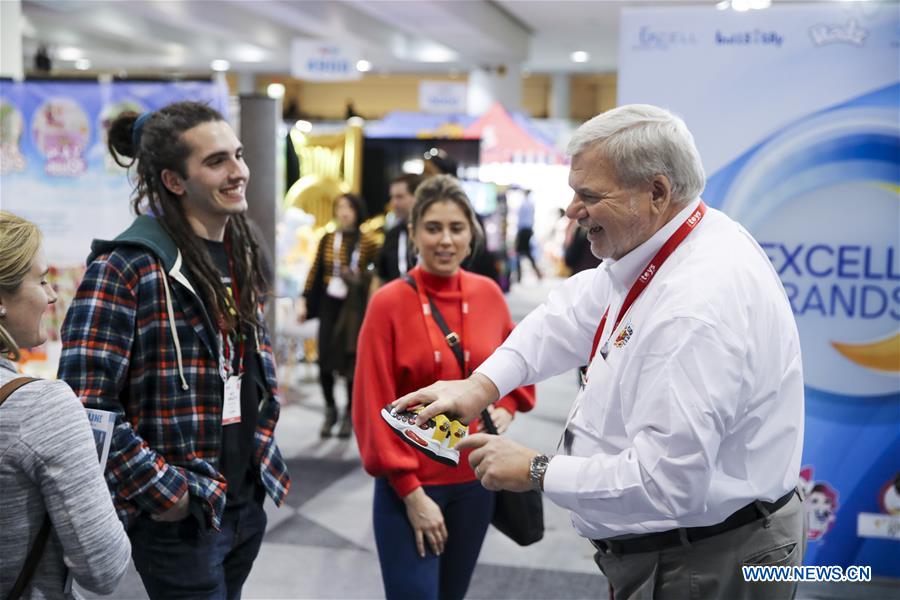
Ken Silvestri (1st R), a staff worker of Choo Choo Shoes, shows the company's products to visitors at their booth during the 116th Annual North American International Toy Fair at the Jacob K. Javits Convention Center in New York, the United States, on Feb. 18, 2019. Imposing more tariffs on China would cripple the business of small U.S. toy companies that have made many success stories with their Chinese partners during the past decades, an industry insider has warned. "I think it would put us out of business. It would put most of the companies in our industry out of business," said Bob Grubba, founder & CEO of Choo Choo Shoes, in an interview with Xinhua at the New York Toy Fair last week. (Xinhua/Wang Ying)
NEW YORK, Feb. 24 (Xinhua) -- Imposing more tariffs on China would cripple the business of small U.S. toy companies that have made many success stories with their Chinese partners during the past decades, an industry insider has warned.
"I think it would put us out of business. It would put most of the companies in our industry out of business," said Bob Grubba, founder & CEO of Choo Choo Shoes, in an interview with Xinhua at the New York Toy Fair last week.
Choo Choo Shoes, based in Ormond Beach, Florida, specializes in producing fun kids shoes that make train sounds.
Grubba said he is closely following the ongoing U.S.-China trade talks and hopes the two sides would make a final deal on stopping the trade frictions that already hurt the U.S. toy industry.
"The model train industry in the United States is a fairly small business ... but a lot of the companies and people (are) involved, and they are all having similar structure," he said.
"Most of these companies have a profit margin in the range of 30 percent. We call it gross profit. If we were to pay a 25-percent tariff, it would only leave approximately 5 percent left to pay rent, insurance and other bills. It's not enough," he lamented.
The White House has threatened to increase the tariffs to 25 percent from 10 percent on the 200 billion U.S. dollars of Chinese imports into the country if the two sides fail to reach an agreement on the solution of trade frictions before March 1.
Ahead of the deadline, Chinese and U.S. negotiators on Sunday wrapped up the latest round of trade talks with substantial progress on specific issues.
U.S. President Donald Trump later tweeted that he "will be delaying" the increase of tariffs on Chinese imports scheduled for March 1, citing "very productive" trade talks between the two countries.
Grubba also downplayed the option of a price hike.
"Because our products are already fairly expensive, if we were to increase the price, try to pass that cost onto our customers, I don't think they would pay it. I think we would sell less," Grubba said.
"So I think it would put us out of business. I think it would put most of the companies in our industry out of business. So the model train industry in the U.S. would just go away," said Grubba while making a throat-slitting gesture.
The idea to relocate production out of China is also unrealistic, he added, noting that it is hard for toy industry businesses to find another country with comparable infrastructure, skilled workers, as well as the research and development capabilities.
"It's difficult to move a factory (out of China) because our product is very specialized. It took us a long time to train the workers at the factories and train the engineers and get the quality the way it's supposed to be," he said. "And if we try to move to another country, then you have to develop that expertise all over again. And that takes a long time, a lot of money to do that."
"The Chinese factories need to sell stuff, we need to buy stuff. It's a good relationship. And I just hope that (the relationship) won't get wrecked," he said.
According to The Toy Association, a trade association for U.S. toy companies, the industry has over a thousand members, 95 percent of whom are small businesses. The industry supports about 700,000 U.S. jobs, with annual sales of about 22 billion U.S. dollars.