
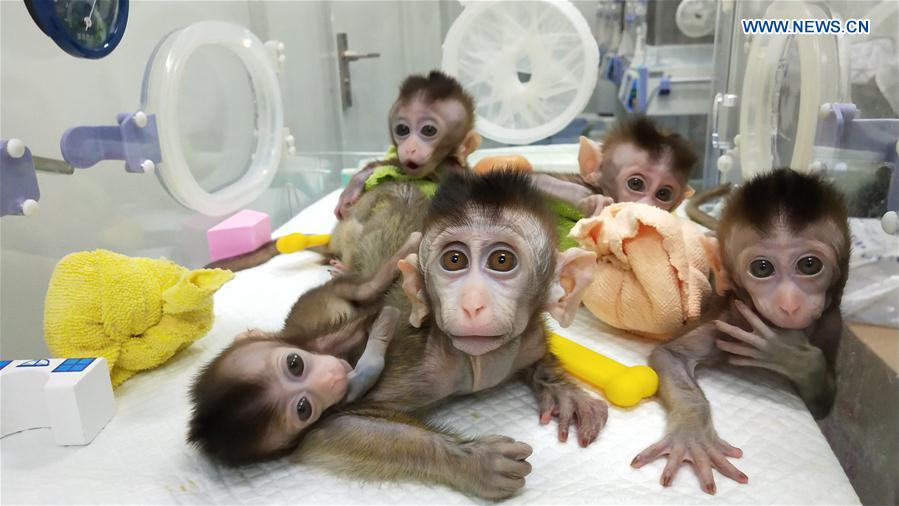
Photo taken on Nov. 26, 2018 shows the five cloned monkeys with circadian rhythm disorders. China has cloned five monkeys from a gene-edited macaque with circadian rhythm disorders, the first time multiple monkeys have been cloned from a gene-edited monkey for biomedical research. Scientists made the announcement Thursday, with two articles published in National Science Review, a top Chinese journal in English. The cloned monkeys were born in Shanghai at Institute of Neuroscience of Chinese Academy of Sciences. (Xinhua/Institute of Neuroscience of Chinese Academy of Sciences)
SHANGHAI, Jan. 24 (Xinhua) -- China has cloned five monkeys from a gene-edited macaque with circadian rhythm disorders, the first time multiple monkeys have been cloned from a gene-edited monkey for biomedical research.
Scientists made the announcement Thursday, with two articles published in National Science Review, a top Chinese journal in English. The cloned monkeys were born in Shanghai at Institute of Neuroscience of Chinese Academy of Sciences.
Researchers said that the advance means that a population of customized gene-edited monkey models with uniform genetic background will be available for biomedical research.
Disorders of circadian rhythm are associated with many human diseases, including sleep disorders, depression, diabetic mellitus, cancer and neurodegenerative diseases, such as Alzheimer's disease.
Previously, mice and flies were widely used for the research of such diseases, but these animal models differ greatly from human beings in terms of activity routines, brain structure and metabolic rate.
The cloned monkeys, closer to human in physiology, make better models for research on disease pathogenesis and potential therapeutic treatments.
In order to create an ideal donor monkey, researchers knocked out BMAL1, a core circadian regulatory transcription factor, using gene editing at the embryo stage.
They selected one of the gene-edited monkeys with the most severe disease phenotypes as the donor. The fibroblasts of the donor were then used to clone five monkeys by somatic cell nuclear transfer, the same method used to generate Zhong Zhong and Hua Hua, the first cloned monkeys born in China at the end of 2017.
Different from Zhong Zhong and Hua Hua, generated by using fibroblasts from an aborted fetus, the new clones were made using a gene-edited young adult male monkey.
"It shows that besides using fetus, batch cloning of gene-edited male monkeys with diseases is also feasible," said Qiang Sun of the institute.
Sun said the research program was reviewed and supervised by the institute's ethic committee in accordance with international ethical standards of animal research.
He said that the research signified the maturing of China's somatic cell cloning.
Muming Poo, the director of the institute, said that the research team would focus on cloning monkey models with different brain diseases in the future.
Besides being used to study human brain diseases, the models will be used to test medicine effectiveness, which can help reduce the number of animal models used in experiments and lower the cost of medicine development, he said.