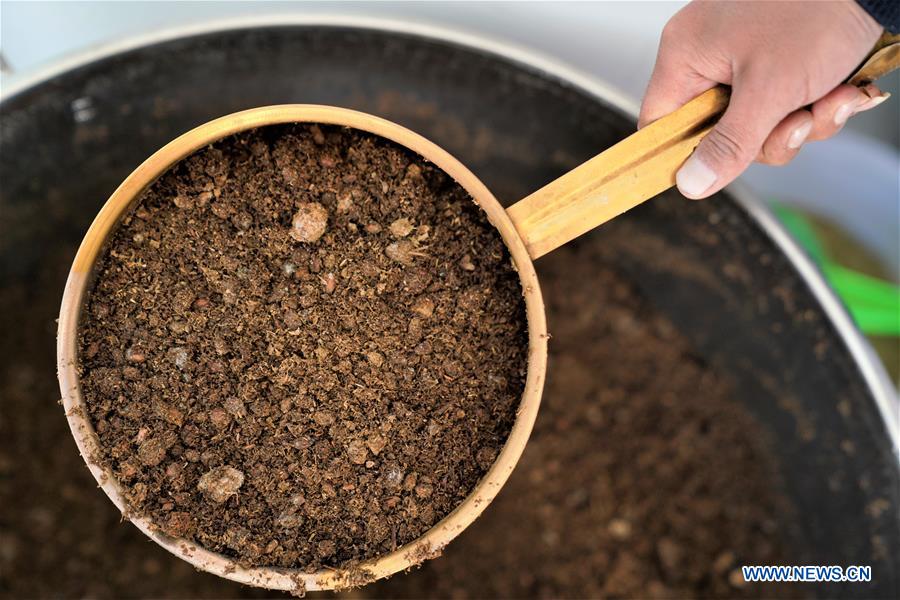
Photo taken on Nov. 21, 2018 shows the herbs of Lum medicinal bathing of Sowa Rigpa in southwest China's Tibet Autonomous Region. The United Nations Educational, Scientific and Cultural Organization (UNESCO) inscribed on Wednesday China's Lum medicinal bathing of Sowa Rigpa on the Representative List of the Intangible Cultural Heritage of Humanity, at a convention held in Port Louis, capital of the Republic of Mauritius. The Lum medicinal bathing of Sowa Rigpa is knowledge and practices concerning life, health and illness prevention and treatment among the Tibetan people in China. In Tibetan, "Lum" indicates the traditional knowledge and practices of bathing in natural hot springs, herbal water or steam to adjust the balance of mind and body, to ensure health and treat illnesses. Sowa Rigpa, the Tibetan name of the medicinal practice, literally meaning the knowledge of recuperating, was originated on the Qinghai-Tibet Plateau with an average altitude of 4,000 meters above the sea level. The traditional Tibetan medicine prescriptions of treating illness with herbs and minerals date back 2,500 years. (Xinhua/Purbu Zhaxi)
PORT LOUIS, Nov. 28 (Xinhua) -- The United Nations Educational, Scientific and Cultural Organization (UNESCO) inscribed on Wednesday China's Lum medicinal bathing of Sowa Rigpa on the Representative List of the Intangible Cultural Heritage of Humanity.
The decision was announced during the 13th session of the UNESCO Intergovernmental Committee for the Safeguarding of the Intangible Cultural Heritage held from Monday to Saturday in Port Louis, Mauritius.
The Lum medicinal bathing of Sowa Rigpa is the knowledge and practices concerning life, health and illness prevention and treatment among the Tibetan people in China.
Speaking after the decision to inscribe this intangible cultural heritage on the list, Chinese Vice Minister of Culture and Tourism Zhang Xu said that Lum medicinal bathing of Sowa Rigpa has an important bearing on the everyday life of people of the Tibetan ethnic group.
"This heritage not only embodies the folk experience in disease prevention and treatment, it also represents an inheritance and development of the traditional Tibetan medicine theories in modern health practices," Zhang said.
In Tibetan, "Lum" indicates the traditional knowledge and practices of bathing in natural hot springs, herbal water or steam to adjust the balance of mind and body, to ensure health and treat illnesses.
The Lum Medicinal Bathing of Sowa Rigpa (Tibetan Medicine) has been developed by the Tibetan people with a life view based on Jungwa-nga (five elements) that includes Earth, Water, Fire, Wind and Space, and a view about health and illness.
The knowledge and practices are widely distributed in areas inhabited by Tibetans in China's Tibet Autonomous Region as well as provinces including Qinghai, Sichuan, Gansu and Yunnan, according to China's Ministry of Culture and Tourism.
Approved by the State Council of the Chinese government, Lum medicinal bathing of Sowa Rigpa was included in the National List of Representative Elements of Intangible Cultural Heritage on two occasions in 2008 and 2014.
A five-year safeguarding plan (2019-2023) has been made on the basis of a monitoring system so as to ensure coordinated safeguarding and development of the Tibetan tradition. Measures include special vocational training and increasing youth's awareness of safeguarding through compilation of primary and secondary school textbooks on related knowledge.
With the inscription of the Lum medicinal bathing of Sowa Rigpa, China now has 40 inscribed elements in total on relevant UNESCO lists, including 32 elements inscribed on the Representative List of the Intangible Cultural Heritage of Humanity, 7 elements inscribed on the List of Intangible Cultural Heritage in Need of Urgent Safeguarding, and one program selected to the Register of Good Safeguarding Practices.
During the session of the intergovernmental committee, 40 requests for inscription on the Representative List of the Intangible Cultural Heritage of Humanity are being examined. Another seven elements are proposed for inscription on the List of Intangible Cultural Heritage in Need of Urgent Safeguarding.