HARBIN, Sept. 6 (Xinhua) -- Driving his old banger along a path, Fu Jianguo started his daily work patrolling the Zhalong National Nature Reserve, where red-crowned cranes were roaming in reeds.
Fu, 56, called those birds in the vast marshland his beloved "children" that require national protection.
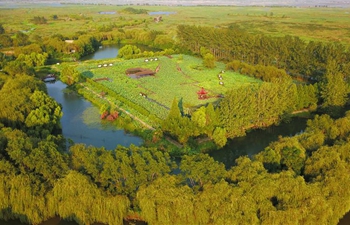
Located in northeast China's Heilongjiang Province, the Zhalong nature reserve serves as the habitat of over 190 types of rare birds like red-crowned cranes.
Among the rare birds, the red-crowned cranes and the oriental white storks are closely monitored by Fu, who is head of a wildlife protection association in Lindian County, where part of the nature reserve locates.
With their population both below 3,000 nationwide, the red-crowned cranes and the oriental white storks are listed as endangered species that are under first-class national protection.
"My home was like a zoo in my childhood," he said, recalling the abundant wetland and rare birds in the county in the past.
To Fu, protecting local wildlife was kind of family tradition, as his father also took care of cranes and other wild animals for zoos before retirement.
"My favorite thing was squatting down and observing them," he said.
Fu started his wildlife protection career in 1984 when the then 22-year-old youngster became a local guide for a wild life research institute.
Protecting wildlife is by no means easy in Heilongjiang, where long and bitterly cold in the winter brings major challenges for Fu during his fieldwork.
Sometimes it means risking his own life. During a freezing winter day in 2014, Fu plowed his way through the frozen wetlands and found a bird traps hidden in the snow. While rushing to remove them, he fell into an icy pit, and his clothes were frozen in just a minute.
While conducting fieldwork a few days later, he fell from the roof of his car and injured himself. He was in shock and was rushed to the emergency room where it took him over an hour to come around.
While the cold weather was challenging and dangerous, cracking down on poachers posed even more of a threat.
"A hunter put his gun to my head, ordering me to stop intervening," Fu said, recalling the most dangerous moment in his career about 23 years ago when Fu and some police officers confiscated guns from poachers in the reserve after being informed by locals of illegal hunting.
"I wasn't scared, because I believe evil never prevails over good," he said. Thanks to their quick response, no birds were harmed by the poacher.
Facing so many difficulties and dangerous situations, Fu once thought of giving up. However, those thoughts disappeared as soon as he saw his beloved red-crowned cranes, oriental white storks and others birds living happily in their natural habitat.
China has made notable progress in ecological protection in recent years, and non-governmental organizations with increasing numbers of volunteers are playing an important role.
Fu and over 60 volunteers on his team have saved and set free hundreds of birds under first-class national protection in the past 34 years. Now, his team receives up to 15 phone calls a day for help from wildlife protectors across the country.